
World Models based on Information Markets vs Physical World Models
Capital allocation, policy response, strategic planning: the decisions that matter most under uncertainty still rely on narrative intelligence.
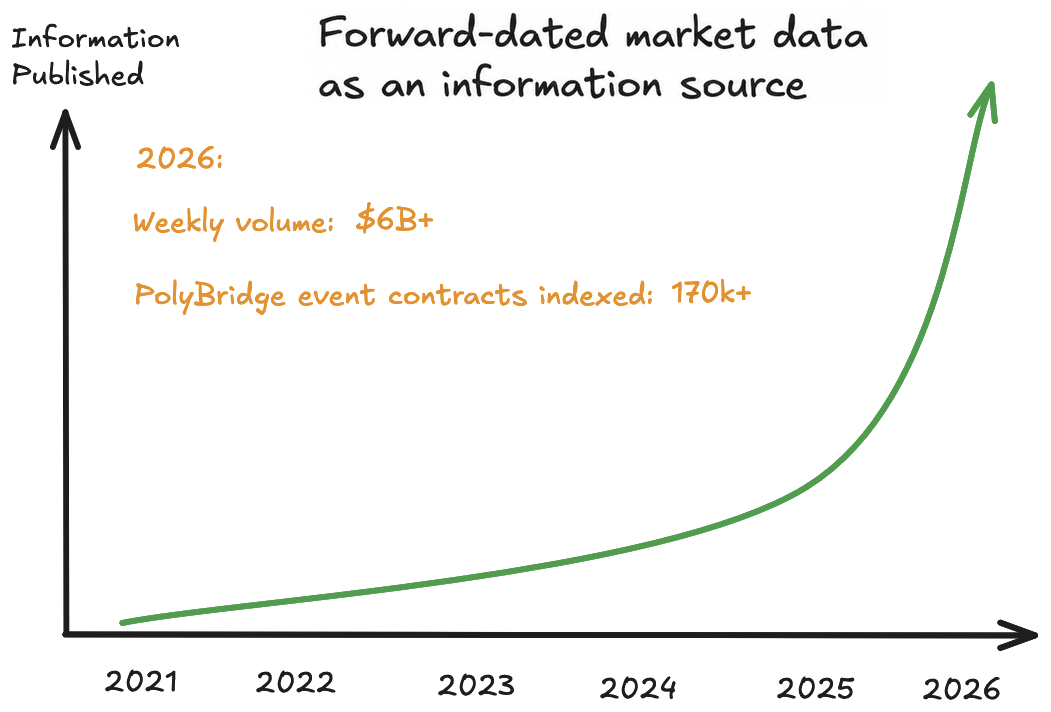
Consultant memos, analyst calls, red teaming exercises. Markets now generate over $6B in weekly trading volume, producing forward-dated market data about the future state of policy, geopolitics, and macro regimes. This raw signal can be converted into structured, causal, general intelligence on the future state of the world.
Most world models track objects in space and time. Fei-Fei Li’s taxonomy [1] covers renderers, simulators, and planners for the physical world. LeCun’s JEPA [2] learns latent structure from observation streams like video and images. Neither addresses the domain that information markets are concerned with: policy decisions, geopolitical dynamics, macro regimes, and their consequences.
‘Informational’ as opposed to physical world models build a structured model of what information markets believe about the world. The scope is defined by the observation channel: 100k+ markets across macro, geopolitics, policy, equity risk, and social topics, extending to new domains as new markets arise.
Forward-dated market data is uniquely suited as an observation channel because participants with wrong beliefs lose money, making the signal self-correcting at the population level.
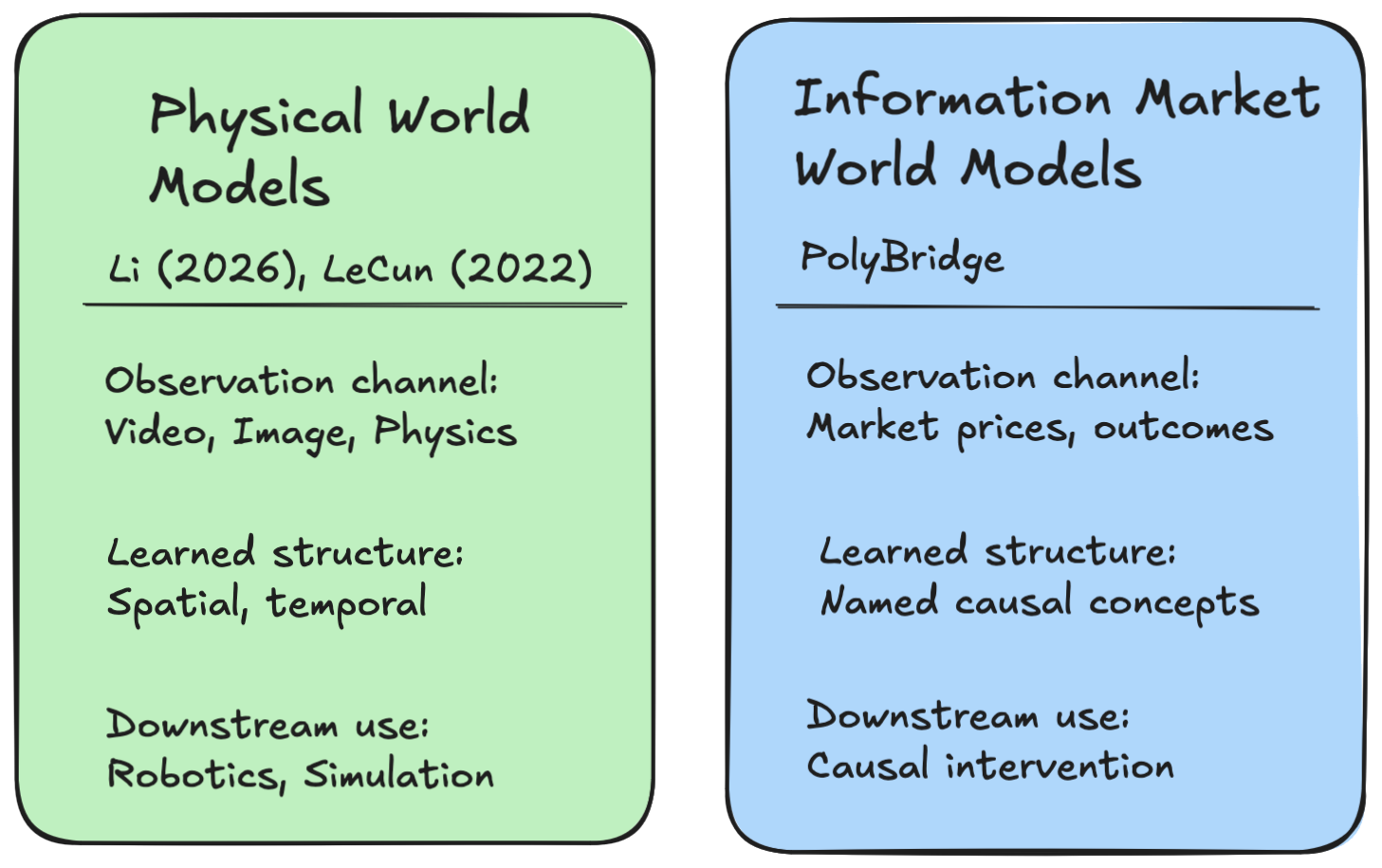
JEPA and PolyBridge operate at different levels
LeCun’s JEPA specifies how to learn a latent representation from observation streams. It does not specify what those representations should mean, whether causal surgery should be possible, or how outputs connect to decision-making under named uncertainty.
Information market world models specify what a world model must satisfy to be useful within the world of policy, geopolitics, macro regimes, and other market-elicited information: named concepts, causal edges, intervention and counterfactual support, auditable outputs. It is not prescriptive about how concepts and their interactions are discovered.
Direct comparison of information market world models and JEPA is a category error.
JEPA is one option for learning inside information market world models. For example, learning latent dynamics from market observation streams, but this has tradeoffs: notably, its embeddings are uninterpretable by construction, requiring a projection step to produce the named concepts the decision layer demands.
How structure enters the Information Market World Model
Concepts at the decision layer must be named, causally structured, and interpretable. Three epistemologically distinct approaches exist:
Specification: Encode prior knowledge about concepts and causal edges directly. This was the dominant approach since the 1980s expert systems era, and could be high quality, but it did not scale. Thirty concepts took months of specialist time. Post-2023, LLMs lift that bottleneck on eliciting expert-knowledge prior specifications. They compress thousands of domain specialists into a callable function: comparable specification quality for well-covered domains, orders of magnitude faster. Probabilistic graphical models (PGMs) become viable products once specification scales.
Structure learning: Discover graph structure from data. The PC algorithm and FCI (Spirtes, Glymour, Scheines, 1993) test conditional independence to propose edges. Historically limited by data requirements and sensitivity to assumption violations. Applying them to inferred latent trajectories rather than raw observables is a more recent development, aided by the unprecedented scale and resolution of resolved outcomes now available alongside forward-dated market data.
Representation learning: JEPA-style methods learn embeddings end-to-end with no prior specification of what dimensions mean. Applicable where unnamed representations are acceptable. The projection from unnamed embeddings to named causal concepts is non-trivial and remains an active research problem.
A fourth source of structural knowledge crosscuts all three: interventional evidence. When a contract underlying forward-dated market data resolves, or a policy decision takes effect, the downstream causal consequences become observable. These are natural experiments that reveal causal direction in a way that passive observation cannot. Resolved outcomes are the system’s strongest signal for validating and refining structure, regardless of how that structure was initially proposed.
The three approaches are not mutually exclusive. A single system can use LLM-based expert specification for priors on well-understood causal relationships, structure learning to discover edges the specification missed, and learned embeddings for residual dynamics that neither approach captures. The design principle is to use the strongest applicable prior for each piece of structure, and compose freely across approaches for the rest.
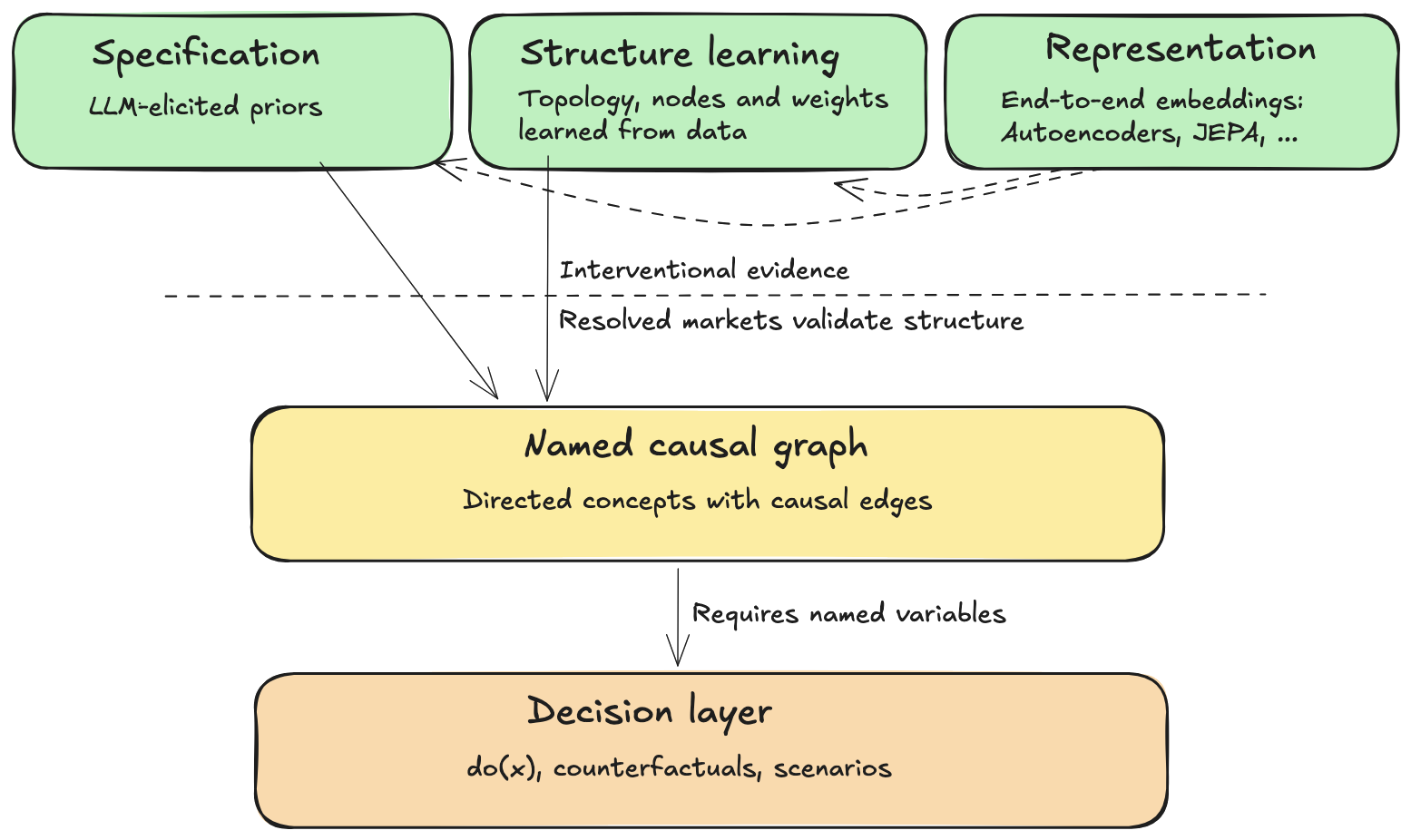
Interpretability at the decision layer is not a preference. Pearl’s do-operator requires named variables with defined parents. You cannot meaningfully reason from interventions based on unnamed and uninterpretable embeddings. Below the decision layer, unnamed representations can feed structure upward through any of the approaches above.
Direction
Physical world models and information world models are closer than the domain gap suggests. Both are latent state estimation problems with noisy observations and partially known dynamics. Information markets usually have lower signal-to-noise than physical sensors, but richer observation semantics: different contract types (binary events, threshold barriers, terminal distributions) carry mathematically distinct evidence about the same latent state. Physical events become market events when they change beliefs and reprice risk. PolyBridge tracks those downstream consequences in the belief state.
Current systems answer questions. The next step is an agent layer that acts on information world model forecasts. The same progression from world model to agent that physical-world robotics requires. When a model knows the causal structure of the world, an agent can reason about interventions, not just predictions.
- Issue
- 2026 · World models, compared
- [email protected]